¶ Introduction
The following page gives list of the available process units in DYNAMIZU, with a short description of their features.
¶ Process units
¶ Membranes
¶ Simple MF
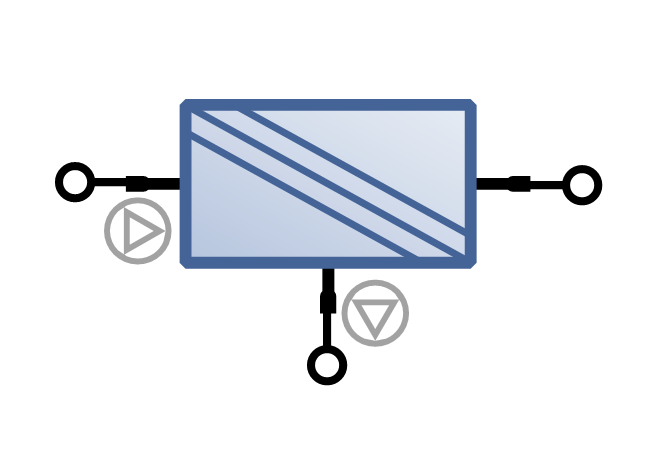 |
Mass balance based volumeless point separator model with input recovery (effluent flow rate fraction) and input solids and colloids rejection. |
|---|
This unit offers two configuration options:
- cross-flow (continuous operation)
- dead-end (alternating operation of filtration and washing phase)
In the latter version, filtration and backwash phase lengths can be specified along with air scour duration and airflow for the washing phase. The energy demand of pumping and aeration is calculated when the Energy model is turned on.
¶ Advanced MF
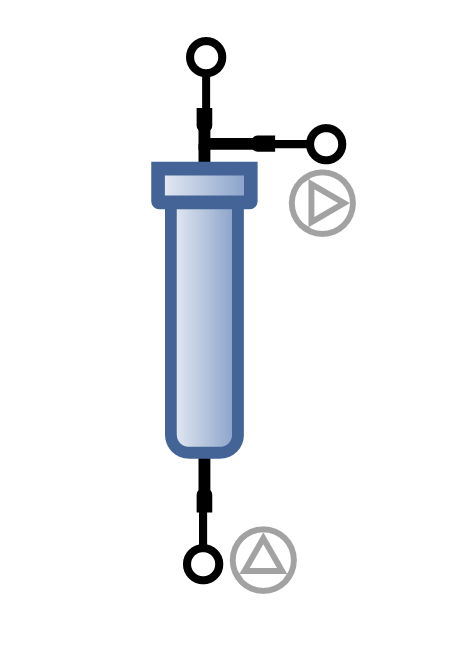 |
Mass balance based volumeless point separator model with input recovery (effluent flow rate fraction) and input solids and colloids rejection; extended with pressure and membrane flux calculations. |
|---|
This unit offers two configuration options:
- cross-flow (continuous operation)
- dead-end (alternating operation of filtration and washing phase)
In the latter version, filtration and backwash phase lengths can be specified along with air scour duration and airflow for the washing phase. The energy demand of pumping and aeration is calculated when the Energy model is turned on.
Pressure calculations are based on membrane surface area, permeability and fouling, with input filtrate back pressure. Membrane flux is calculated from filtrate flow and membrane surface area.
¶ Advanced UF - cross flow
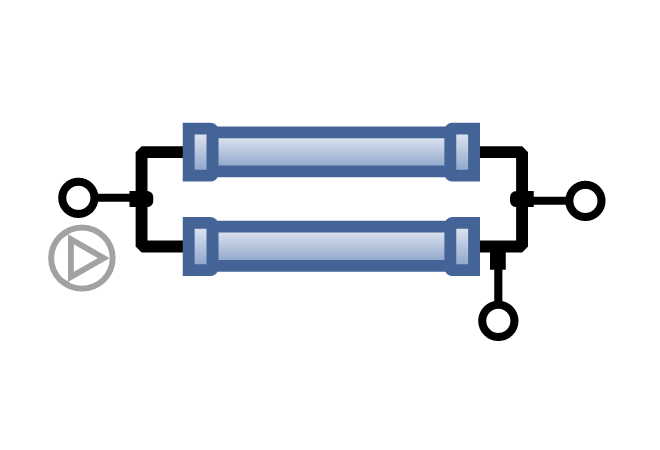 |
Volumeless point separator model with input rejections and input recovery (effluent flow rate fraction) or feed pressure; extended with pressure and membrane flux calculations. |
|---|
This unit process is dedicated for mass-balance simulation of continuous ultrafiltration membranes in ultrapure water production. It is centered around an instantaneous mass balance separator of suspended and colloidal contaminants.
This unit offers two options for operation strategy:
- set recovery ratio (permeate flow fraction)
- set feed pressure
For the first option, pressure calculations are based on membrane surface area, permeability and fouling, with input permeate back pressure. For the second one, permeate flow is calculated from the driving pressure, derived from the feed and permeate back pressure inputs. Membrane flux is calculated from filtrate flow and membrane surface area.
¶ Advanced UF - dead-end
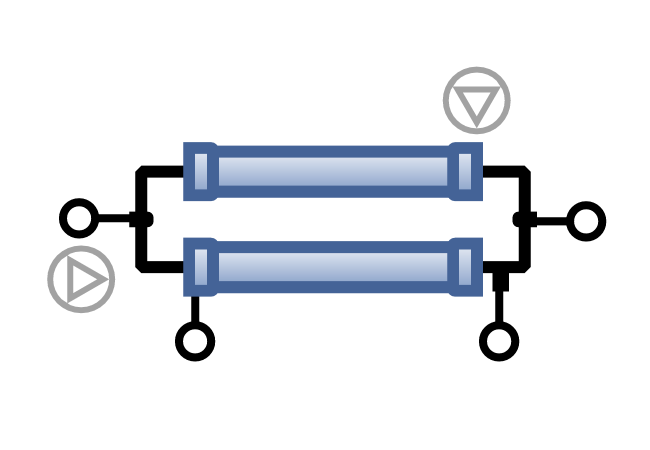 |
Volumeless point separator model with input rejections and continuous or cyclic process flow modeling concept. |
|---|
This solids and colloids mass balance separator model was developed with typical rejection parameters of chemical precipitates, silica and humic substances in water purification, and is coupled with a pumping energy and chemical cost estimator.
The continuous process flow concept can deal with parallel trains of UF, and offers two options for hydraulic balance setup:
- set recovery ratio (filtrate flow fraction)
- set backwash fluxes
Regular backwash sequences are an integral component of the process, meanwhile, chemical-enhanced backwash and cleaning procedures can be enabled or disabled. In the former case, they are simulated as a continuous process flow, with chemical- and energy-consuming steps (such as air scouring and solution heating) simplified and projected onto the entire duration of procedures. Conceptually, filtrate is pumped for backwash, while washwater is added for cleaning.
The cyclic process flow concept is designed for modelling flux deterioration and trends in transmembrane pressure, dealing with only one train of UF. Chemical-enhanced backwash and cleaning procedures can be enabled or disabled. In the former case, they are simulated cyclically, along with backwash and membrane replacement events. Since this model version is dedicated for energy and cost optimization, not detailed mass balancing, as a conceptual simplification, filtrate is not stored for backwash or cleaning, (washwater is added instead) and forward flush is also modeled using washwater instead of feed.
¶ Simple RO
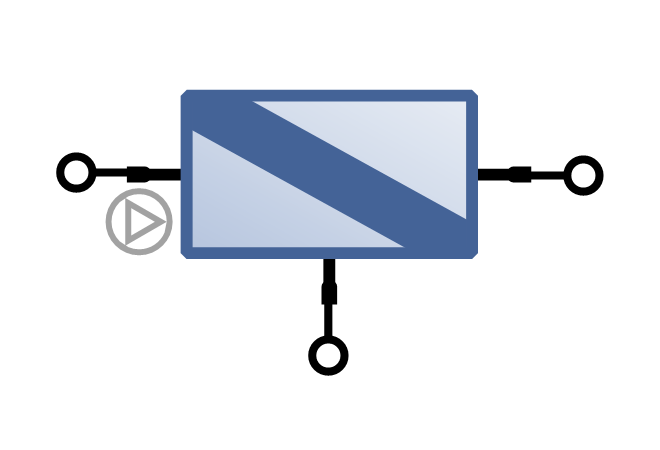 |
Mass balance based volumeless point separator model with input recovery and input rejections; including optional scaling risk calculations (with input antiscalant dose). |
|---|
This unit offers two options for recovery specification:
- recovery ratio (permeate flow fraction)
- permeate flow
Brine recirculation options can be specified as:
- not recirculated
- fraction of brine flow recirculated
- brine flow for recirculation
¶ Advanced RO
|
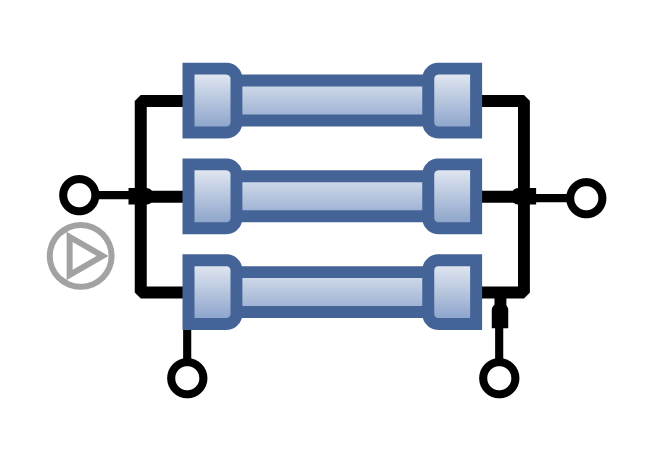
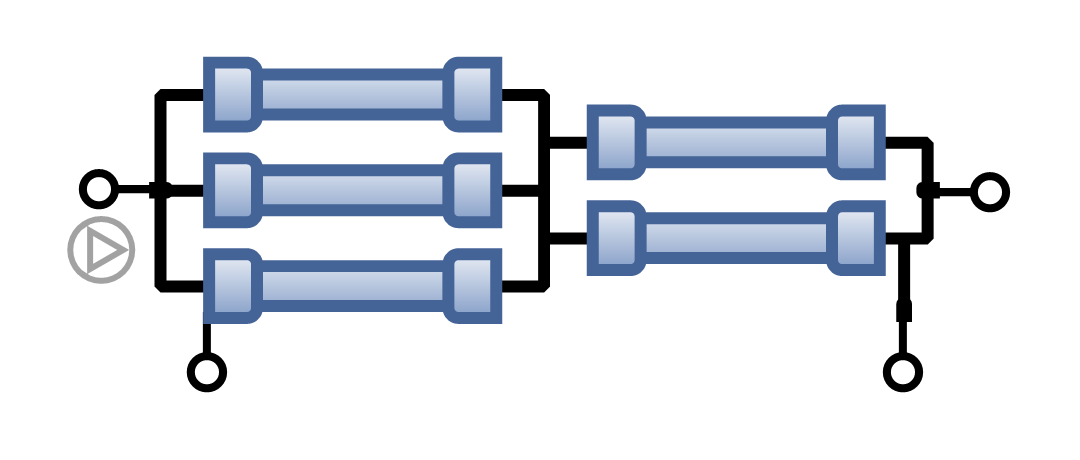
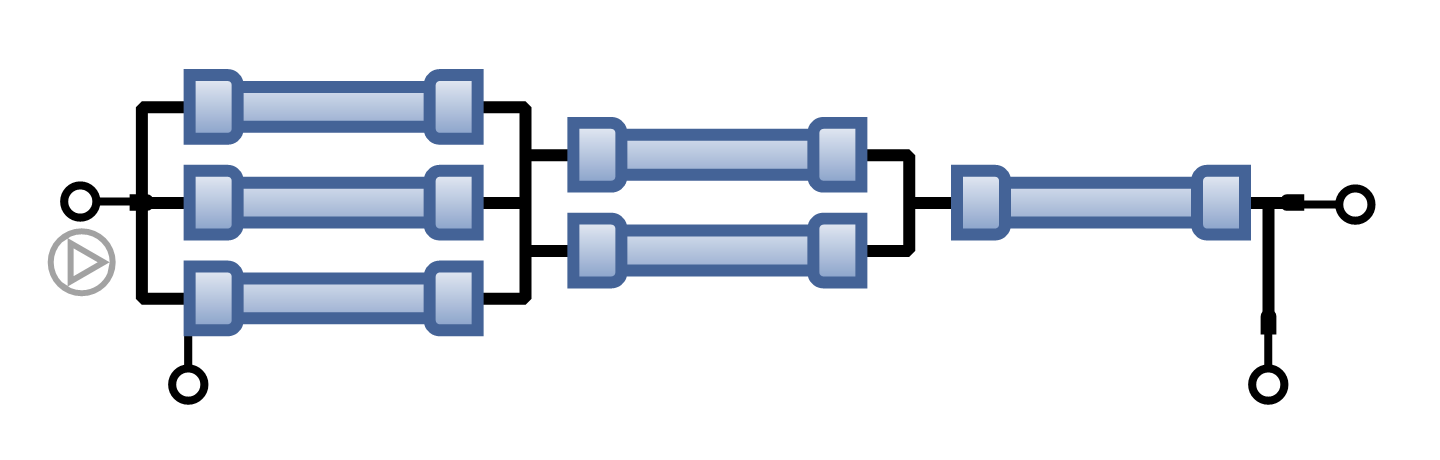
Volumeless point separator model with input rejections and continuous or cyclic process flow modeling concept; available as one-stage, two-stage or three-stage (vessels in series) configuration. |
||
|---|---|---|
|
|
|
This unit is available in two process flow modeling approach, regarding the handling of fouling:
- continuous (set fouling as input parameter)
- cyclic (predicting fouling)
The operational strategy can be specified as:
- set recovery ratio (permeate flow fraction as input parameter)
- set feed pressure (predicting permeate flow)
Brine recirculation can be considered as:
- not recirculated
- specified fraction of brine is recirculated
- specified flow of brine is recirculated
The unit offers various options for specifying high and low pH cleaning chemical solutions as well.
¶ Membrane cleaning model
Common use cases of models in the field of water treatment and reuse include mass balance analysis for effluent quality estimation, scaling risk assessment, brine production and related waste management cost calculation, along with strategical development for increasing energy efficiency, planning operation and maintenance-related strategies.
For this purpose, a dynamic fouling and cleaning concept predicting permeability is proposed, focusing on an engineer-oriented approach reproducible for conducting similar studies, with equations and parameters aiming at a straightforward comprehension of the basic underlying mechanisms. To simulate RO performance over time permeability (Lp) is introduced as an integrated state variable – highest at the startup of a treatment plant, decreasing as membranes are clogged and used, and restored to certain degree during cleaning cycles. Differential equations and event code were implemented to simulate these operating and maintenance phases.
Permeability change during membrane filtration is predicted by a first order decay formula shown below, flux decrease will be more significant the higher the permeability is (the model predicting a hyperbolic decrease towards zero without any cleaning event). This corresponds to actual operational trends as flux loss is not linear with time, most of it occurs towards the beginning of a membrane’s life cycle (AlSawaftah et al., 2021).

Where Lp: Membrane permeability at 25 °C (L m-2 h-1 bar-1),
rLp,dec: Permeability decline rate coefficient (d-1).
The model assumes that the decline rate coefficient is constant within all filtration cycles of membrane system operation. The effect of irreversible clogging and mechanical ageing on the maximum regained permeability after cleaning is considered – the initial permeability at the commissioning of an RO plant will never be restored, as a portion of fouling cannot be removed throughout the cleaning procedures. The next equation calculates the derivative of the maximum restorable permeability according to a perfect cleaning procedure, which is a first order saturation-based approach, the driving force of flux recovery is determined by the difference of the permeability at infinite age (the start-up property of a new membrane multiplied by the irreversible fouling potential) and the actual maximum restorable permeability at the time.

Where Lp,max,clean: Maximum restorable permeability by cleaning, at 25 °C (L m-2 h-1 bar-1),
rLp,max,clean,dec: Cleaning maximum restorable permeability decline rate coefficient (d-1).
Fageing,sat: Irreversible fouling and ageing potential (-),
Lp,new: Permeability of a new membrane at 25 °C (L m-2 h-1 bar-1).
This concept is also useable in ultrafiltration maintenance strategies, where specific maximum restorability decline rates may be specified regarding backwash and CEB cycles, that are in effect, overwritten by higher maximum values when cleaning procedures are executed. The equation below describes the impact of cleaning on recovering permeability, where the cycle-specific recovery rate coefficient can further be adjusted based on the efficiency of the procedure. It is important to note that this is specific to the cycle overall, since the effectiveness of cleaning generally does not depend on cleaning duration (Gul et al., 2021).

Where rLP,recov,clean: Cleaning cycle-specific permeability recovery rate coefficient (-),
tclean: Duration of cleaning procedure (d).
The fouling and ageing status can be tracked using the factors calculated by the following equations based on the permeability ratios of fouled/cleaned membranes to new ones.


Where Ffouling: Fouling factor (-),
Fageing: Irreversible fouling and ageing factor (-).
In this study the model was calibrated to full-scale measurement data regarding recycled wastewater. Most parameters can be conveniently re-estimated based on bench tests with membrane elements according to the type of feed water, whereas fine-tuning the irreversible fouling potential requires long-term field testing. Permeability of a new membrane may be specified by the manufacturer but is more accurately determined from tests conducted in process water or when commissioning the RO system. Model fitting involves finding a good agreement between feed pressure profile or flux variation.
References:
AlSawaftah, N., Abuwatfa, W., Darwish, N., Husseini, G. (2021). A Comprehensive Review on Membrane Fouling: Mathematical Modelling, Prediction, Diagnosis, and Mitigation. Water 13, 1327.
Gul, A., Hruza, J., Yalcinkaya, F. (2021). Fouling and Chemical Cleaning of Microfiltration Membranes: A Mini-Review. Polymers 13, 846.
¶ Membrane contactor
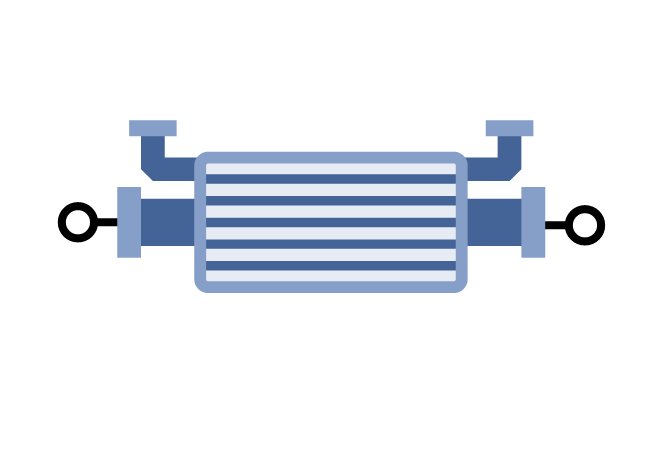 |
Gas-liquid exchange unit with two levels of model complexity. |
|---|
The hydraulics for this unit can be specified in two ways:
- volumeless gas separator
- gas-liquid exchange at lumen interface
The first, empirical option is intended solely for stripping gases from the liquid phase and involves a simple mass balance-based gas state variable separation concept, operating on input percent removal basis. The output gas composition is quantified with the assumption of vacuum conditions, and algebraic exhaust gas estimation is included among the calculations.
The second option is intended for either stripping or dissolving gases from/into the liquid phase and relies on mechanistic equations applying Henry's law and Fick’s two-film theory to predict gas transfer, featuring optional sweep gas input and a pressure control point at the lumen outlet. The unit works under both pressure-driven and vacuum conditions, with dynamic off-gas calculation. Default sweep gas compositions available in the model specification include atmospheric air, pure N2 as an inert gas, as well as pure CO2 for carbonating.
The physical membrane contactor module parameter set – involving the lumen media wall thickness and the liquid-side resistance – represents those of commonly used equipment in water resource recovery (Wadhawan et al., 2020).
Wadhawan T, Reeve M, Astrand N, Házi F, Bencsik D, Takács I. A predictive oxygen transfer-based Membrane Aerated Biofilm Reactor model. In: IWA Biofilms 2020. International Water Association; 2020. p. 121–123.
¶ EDI
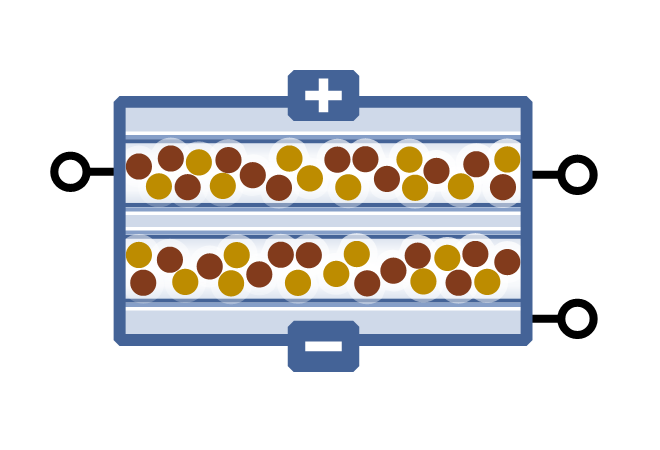 |
Mass balance based volumeless point separator model with input or calculated electric power demand. |
|---|
This unit is specifically designed for ultrapure water production; demin water (RO permeate or ion exchanger effluent) is required as feed. Salt removal depends on input current, or fixed in case of calculated current.
The predicted salt removal depends on the input current based on an exponential saturation function – relating to the theoretical specific Faradaic current. In case the model is set up with calculated current, salt removal is fixed and electric power is calculated, assuming that the ideal Faradaic current is met. Meanwhile, silica and boron removal additionally depend on the Feed Conductivity Equivalent (FCE). This is a formula developed by US Filter to assess the load of ions, TIC and silica on an EDI system.
The unit draws on simplified physics with generally no sizing needed for ion balance and energy calculations, as it is nominalized to manufacturer-based reference electrode rinse flow rates. However, the accurate impact of electrical energy is subject to the voltage specification and the number of cells per EDI module. In the water balance the concentrate stream incorporates both reject water and the electrode rinse stream.
Faraday’s law is used for estimating the required specific current, according to the molar ionic conductivity and the electrode flow rate per module. The total electric current is linked to this by the number of cells, the FCE value, a hydraulic scaling factor accounting for the volumetric flow distribution, as well as an Arrhenius-type temperature sensitivity factor.
The impact of current on EDI performance may be investigated through changing the energy per feed parameter, impacting water quality if the current is too low compared to theoretical Faradaic current. In this approach the input specific current is compared to the half-saturation value tuned based on theoretically required specific Faradaic, current using an exponential type saturation term that is used to correct the maximum salt removal. On the other hand, an exponential inhibition term was developed to simulate the impact of high FCE on silica and boron removal deterioration.
¶ Separators
¶ Screen
 |
Mass balance based volumeless point separator model with specified percent solids removal and underflow solids concentration. |
|---|
¶ Sand trap
 |
Mass balance based volumeless point separator model (vortex grit chamber) with specified input VSS increment or removed sand mass. |
|---|
¶ Oil-water separator
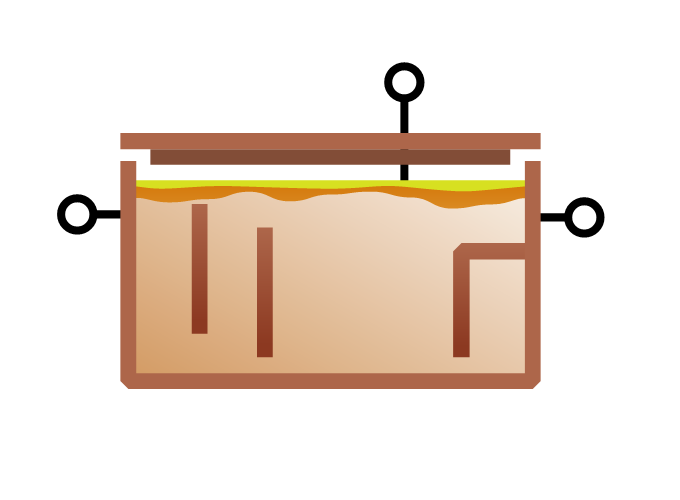 |
Mass balance based volumeless point separator model with specified percent FOG (fat, oil and grease) removal and removed FOG flow fraction. |
|---|
¶ DAF
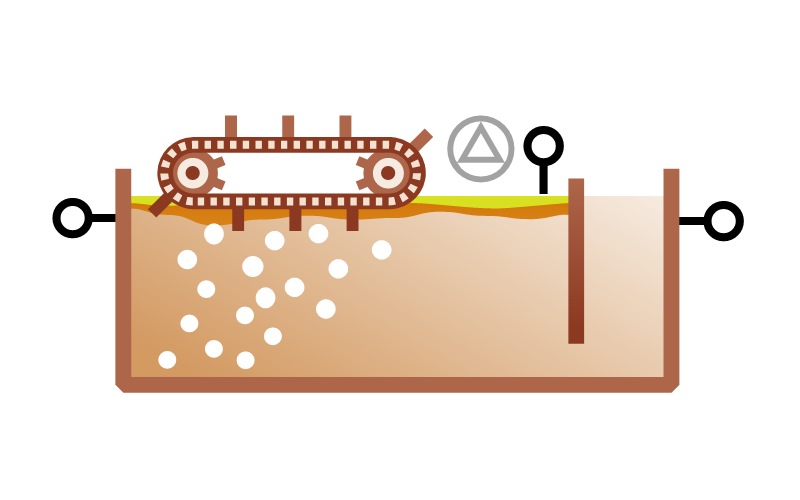 |
Mass balance based volumeless model of Dissolved Air Flotation for simultaneous solids and FOG (fat, oil and grease) removal. |
|---|
The mass balance based algebraic DAF models offer the following input parameter combinations:
Effluent specification:
- fixed effluent solids concentration with specified FOG removal efficiency
- fixed solids removal efficiency with specified FOG removal efficiency
Sludge specification:
- fixed sludge flow
- fixed sludge concentration
¶ Sand filter
 |
Mass balance based volumeless point separator model with backwash flow. |
|---|
The mass balance based algebraic model considers the net result of filter operation (no intermittent stages), offering the following input parameter combinations:
- fixed effluent solids concentration and colloids removal efficiency
- fixed solids and colloids removal efficiency
¶ Point separator
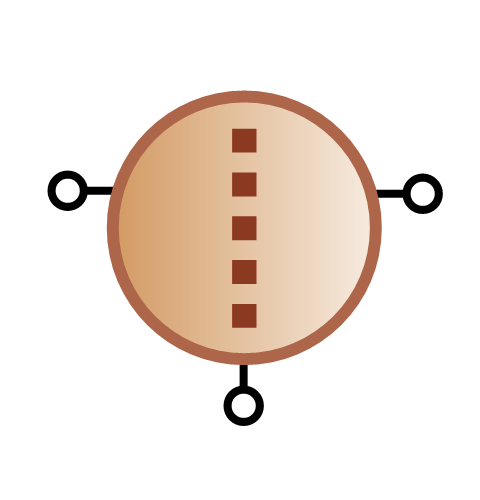 |
Ideal, mass balance based volumeless solids separator unit with various specification options available, as listed out below. |
|---|
- perfect separator with specified recycle flow
- fixed effluent solids
- fixed effluent solids and proportional underflow
- fixed solids removal efficiency
- fixed solids removal efficiency and proportional underflow
¶ Centrifuge
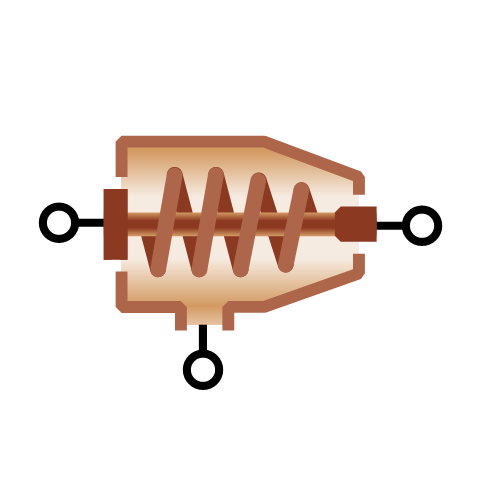 |
General mass balance based volumeless model for describing water treatment residuals dewatering processes. |
|---|
This process unit employs mass balance based algebraic models with the following input parameter combinations:
- fixed solids percent removal efficiency with specified dewatered cake moisture content
- fixed solids percent removal efficiency with specified cake flow
¶ Hydrocyclone
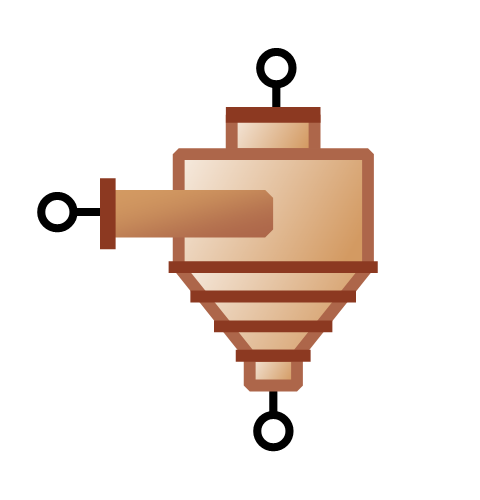 |
Mass balance based volumeless point separator model with specified underflow fraction and state variable separation. |
|---|
This mass balance based algebraic state variable separator model offers two options:
- desanding
- deoiling
Fixed removal efficiencies for the relevant set of state variables are specified as input parameters.
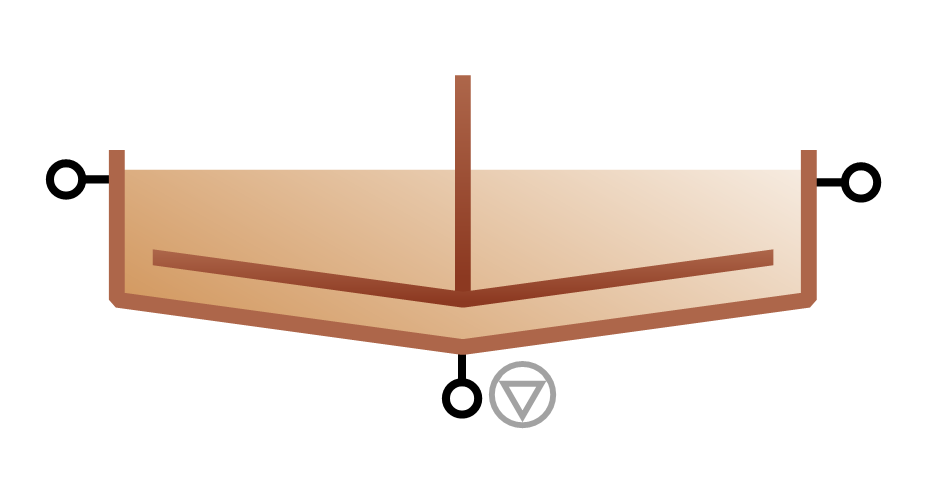
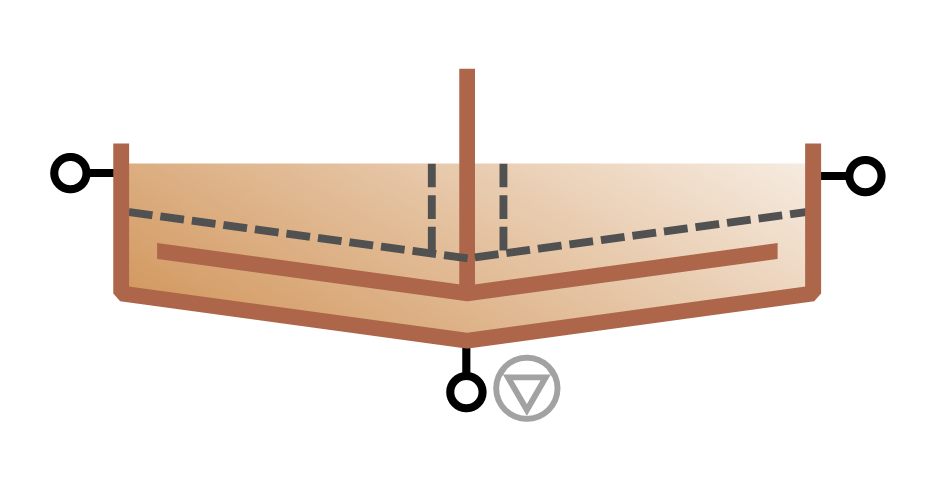
¶ Settler
|
|
Conventional settler model with options for two levels of complexity (volumeless point separator and three-compartment model). |
|---|
The mass balance based algebraic volumeless models offer the following input parameter combinations:
Effluent specification:
- fixed effluent solids concentration
- percent solids removal
Sludge specification:
- fixed sludge flow
- fixed sludge concentration
The reactive three-compartment units consist of a feed well, a clear water compartment and a sludge blanket (offering reactive volumes for each, except for the clear phase), interconnected with volumeless point separators (more details on this can be found in the Process unit specific models chapter). In the feed well, polymer can be added. An elutriation flow allows natural or forced circulation of flow from sludge blanket to clear liquid to account for the diffusion of soluble components. DYNAMIZU offers three-compartment thickener models with the following input parameter combinations:
Effluent specification:
- fixed effluent solids concentration
- percent solids removal
Sludge specification:
- fixed sludge flow
- fixed sludge concentration
¶ Filter press
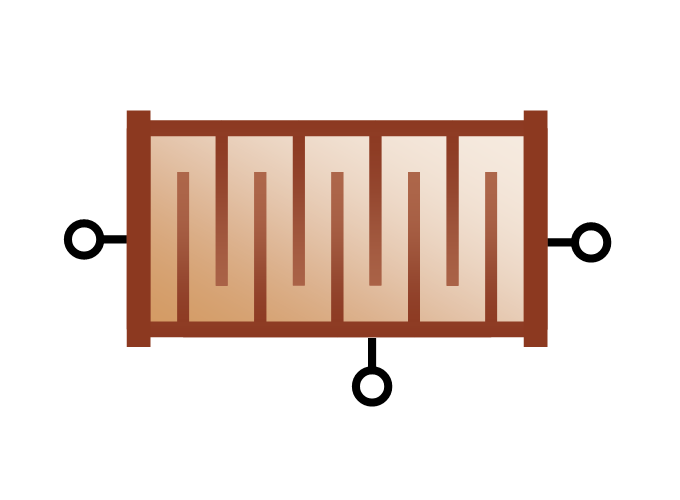 |
General mass balance based volumeless point separator model for describing water treatment residuals dewatering processes. |
|---|
This process unit employs mass balance based algebraic models with the following input parameter combinations:
- fixed solids percent removal efficiency with specified dewatered cake moisture content
- fixed solids percent removal efficiency with specified cake flow
¶ Reactors
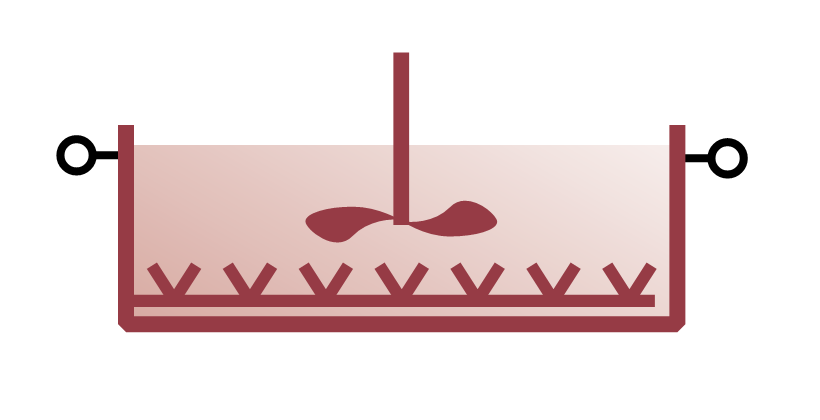
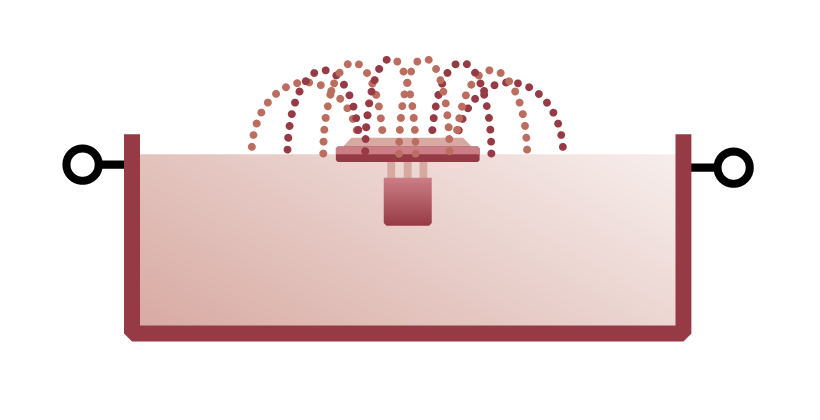
¶ CSTR
|
|
Continuously Stirred Tank Reactor with constant volume and ideally mixed concentration. |
|---|
DYNAMIZU offers various options regarding the aeration process:
Aeration options:
- diffused (with various built-in diffuser system specifications)
- mechanical
Dissolved oxygen handling:
- input DO (air flow requirement is calculated based on proper gas transfer)
- calculated DO (DO is calculated based on input air flow and proper gas transfer description)
- fixed DO (DO is fixed, without accounting for dynamics, while theoretical required airflow is calculated with the built-in aeration model)
The CSTR can also be switched to be non-reactive for specific modeling purposes.
¶ MBBR
 |
Moving Bed BioReactor with ideally mixed bulk phase and conservative media using the SumoBioFilm model with fixed film thickness. |
|---|
The media is described with its specific surface and volume fill ratio, specified by the type of the media used in the system. The biofilm is distributed into layers and diffusion, internal solid transfer, displacement, attachment, and detachment is calculated as transport processes between the layers and between the outer layer and the bulk phase. The latter is considered ideally mixed (alike to a CSTR). Aeration is restricted to diffuser systems.
DO control options:
- Calculated DO (DO is calculated based on input air flow by proper gas transfer description)
- DO controlled in bulk (DO is set and input air flow requirement is calculated based on proper gas transfer description)
¶ MBR
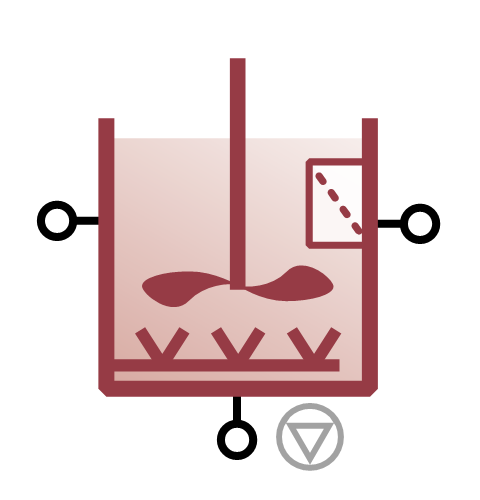 |
Membrane BioReactor with fixed volume and ideally mixed concentration. |
|---|
The membrane bioreactor model consists of a fixed volume aerated reactor (with coarse diffuse aeration system) and an ideal point separator with user-specified effluent solids concentration or percent solids removal.
Dissolved oxygen handling:
- input DO (air flow requirement is calculated based on proper gas transfer)
- calculated DO (DO is calculated based on input air flow and proper gas transfer description)
- fixed DO (DO is fixed, without accounting for dynamics, while theoretical required airflow is calculated with the built-in aeration model)
¶ Reactive filter
 |
Tertiary treatment process unit to describe denitrification filter simulation with. |
|---|
The reactive filter is a complex unit with simplified process approach in a single reactive compartment setup. It comes with flexible backwash and aeration setup: continuous operation or intermittent, depending on dynamic user input. The solids retention is a mass balance based algebraic model offering the following input parameter combinations:
- fixed effluent solids
- fixed solids removal efficiency
¶ Equalization basin
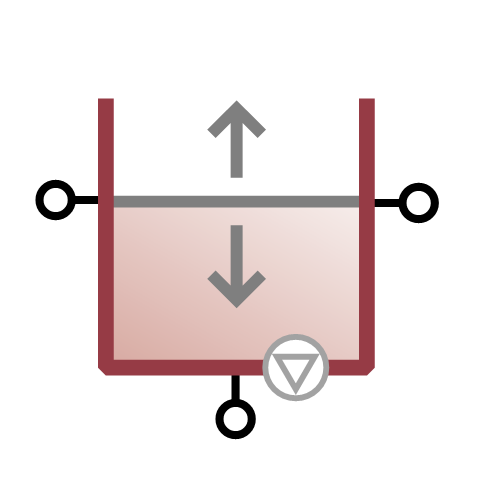 |
Variable volume tank with ideally mixed concentration, featuring pumped output and overflow for flow balancing. |
|---|
This process unit can be set up to be reactive or non-reactive (note that the latter is the default setting). In most aspects it behaves - and can be configured - just like a CSTR, apart from the DO handling (which is always calculated) and the flow dynamics (the EQ tank has a fixed pumped output flow and overflows if the predefined volume is exceeded).
¶ Storage tank

|

|
Unaerated fixed volume tank with or without mixing. |
|---|
This process unit can be used as a relay tank without volume change. Mixing is accounted for its power demand, when the Energy mode is turned on, otherwise the reactor volume is assumed to have a homogeneous concentration distribution. Depending on the modeling purposes, reactions can be switched on or off (the latter is the default setting).
¶ Coagulation tank
 |
Unaerated fixed volume tank with fast mixing for coagulation. |
|---|
This process unit with its default settings is aimed to be used as a reactor for fast coagulation processes. Nevertheless, reactions can be switched off for specific modeling purposes - in that case it will operate as a non-reactive fixed volume storage tank with mixing.
¶ Flocculation tank
 |
Unaerated fixed volume reactor with internal polymer dosage for enhancing flocculation. |
|---|
This process unit is always reactive. The polymer dosage can be specified as:
- Input polymer solution flow rate
- Input polymer solution mass rate
- Dosing point concentration
¶ Flow elements
¶ Feed
|
Initial process unit that represents the incoming liquid flow to the plant. |
||||||||||
|---|---|---|---|---|---|---|---|---|---|---|
 |
 |
 |
 |
 |
 |
 |
 |
 |
 |
 |
In this process unit we define the composition of the feed water based on COD (preferred method, as mass balance can be performed on this basis), DOC or Turbidity.
Three types of feed specification are offered by DYNAMIZU:
- Concentration based (specify concentrations of a few key components combined with feed fractions)
- State variable based (specify the concentration of every state variable)
- SUMO model output (specify the concentration of state variables in combination with feed fractions based on SUMO model outputs)
Most often the concentration based option is used (also being the default choice). For this type of feed, a handy Feed fractionation tool is provided as guidance on setting the proper feed fractions, based on available lab data and common values as reference. The mass flow based option might be better suited for specific applications, while the state variable based option comes handy e.g. when simulation results from one modeled plant are to be transferred to another plant model.
Concentration based as well as state variable based feed units offer a range of options for different source water types, each one coming with a predefined set of “usual” values:
- Municipal effluent
- River
- Lake
- Seawater
- Well water
- Oilfield brine
- Industrial effluent
- Tap water
- Other feed (general)
If pH is considered for the modeling, the pH specification can be done by following approaches:
- Input pH and alkalinity
- Input cations and CO2
¶ Water
 |
Initial process unit representing clean water input for dilution or washing. |
|---|
Specific process unit to represent clean washwater inputs on the drawing board. State variables are set to non-detect values by default, component concentrations can be customized, nevertheless.
¶ Treated water
 |
Terminal process unit representing product output from liquid streams. |
|---|
Specific process unit to represent treated effluent flow leaving the plant. There are no specifications for this unit as it is used solely for reporting results.
¶ Sludge
 |
Terminal process unit representing waste output from solid streams. |
|---|
Specific process unit to represent sludge flow leaving the plant. Five different sludge types can be specified, the choice will only have effect on the operational cost estimations (via disposal fees):
- Screening
- Sand
- Oily waste
- Dewatered sludge
- Water treatment residuals
¶ Concentrate discharge
 |
Terminal process unit representing waste output from liquid streams. |
|---|
Specific process unit to represent concentrate flow leaving the plant. Three different concentrate types can be specified, the choice will only have effect on the operational cost estimations (via disposal fees):
- Liquid brine
- Concentrated slurry
- Cleaning waste
¶ Dividers
 |
 |
 |
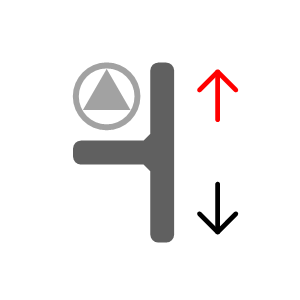 |
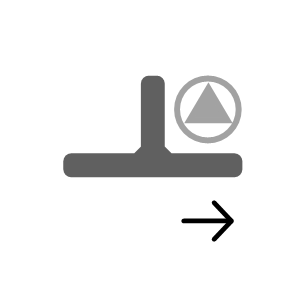
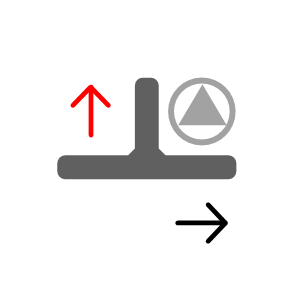
Volumeless non-reactive flow divider units performing mass and heat flow splitting. |
|---|
In most cases, the plant layout employs flow dividers. Sumo offers two geometric variants for these, with the same underlying model:
- Side flow divider
- T flow divider
The flow split between the two outgoing pipes can be specified as:
- pumped: a fixed pumped flow is routed to one pipe (denoted by pump sign), while the remaining (if any) is routed to the other pipe (denoted by grey arrow)
- proportional: a fixed fraction of the incoming flow is routed to one pipe (denoted by pump sign and red arrow), while the remaining is routed to the other pipe (denoted by grey arrow)
The operation of the dividers can be specified as:
- continuous (pump cycling Off)
- cyclic (pump cycling On)
As an exception to the rule, for keeping the layouts clear, ports are not shown graphically for these process units.
¶ Combiners
 |
 |
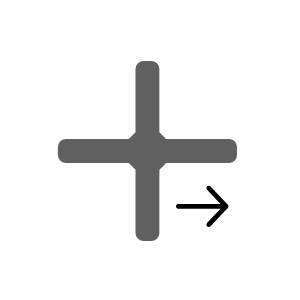 |
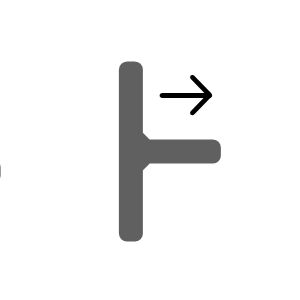
Volumeless non-reactive flow combiner units performing mass and heat flow summation. |
|---|
In most cases, the plant layout employs flow combiners. Sumo offers three geometric variants for these, with the same underlying model:
- Side flow combiner (adjoining two incoming flows arriving from perpendicular pipes)
- T flow combiner (adjoining two incoming flows arriving from two pipes facing each other)
- Multi flow combiner (adjoining three incoming flows)
As an exception to the rule, for keeping the layouts clear, ports are not shown graphically for these process units.
¶ Static mixer
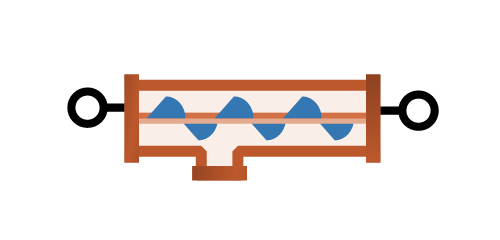 |
Flow unit performing static mixing in a fixed volume. |
|---|
The unit can be set to be reactive or non-reactive (with the latter being the default setting).
¶ Dosage units
¶ Inline pH control
|
|
|
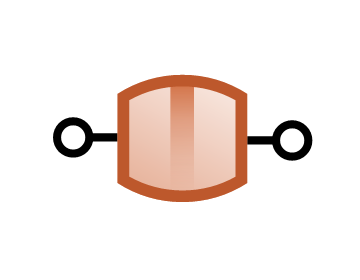
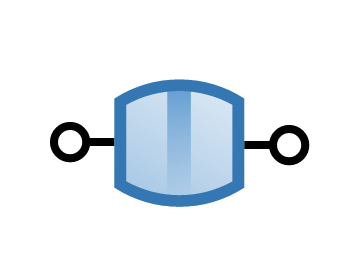
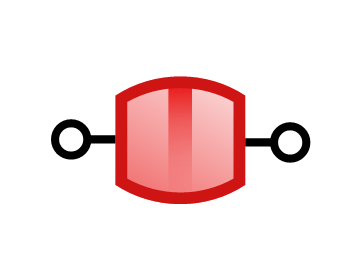
Inline dosage unit for automatic pH adjustment. |
|---|
The inline pH control unit automatically calculates and adjusts the required acid or base dosage in order to meet the set target pH (that is an input parameter) in its output port, pivoting from the pH in its input port. Please note that pH calculations have to be turned on for the meaningful usage of this process unit. For pH control, it uses caustic as base, and offers the choice between two types of acid (sulfuric and hydrochloric).
¶ Carbon dose
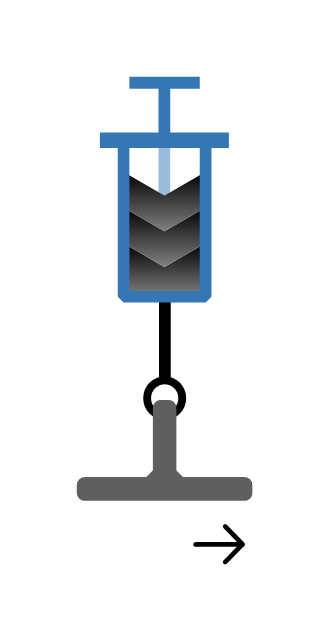 |
Inline dosage unit for carbon addition. |
|---|
The carbon unit can be used to dose two types of carbon sources:
- Methanol
- Readily biodegradable substrate
¶ Polymer dose
 |
Inline dosage unit for polymer addition. |
|---|
The polymer unit can be used to dose polyelectrolytes. The dosage type can be:
- Dosing point concentration
- Mass flow of polymer
- Flow rate of polymer
¶ Acid dose
 |
Inline dosage unit for acid addition. |
|---|
The acid unit can be used to dose four types of acids:
- Hydrochloric acid - HCl
- Nitric acid - HNO3
- Phosphoric acid - H3PO4
- Sulfuric acid - H2SO4
¶ Base dose
 |
Inline dosage unit for base addition. |
|---|
The base unit can be used to dose three types of bases:
- Caustic - NaOH
- Calcium hydroxide - Ca(OH)2
- Magnesium hydroxide - Mg(OH)2
¶ Buffer dose
 |
Inline dosage unit for buffer addition. |
|---|
The buffer unit can be used to dose three types of buffers:
- Sodium bicarbonate - NaHCO3
- Ammonium bicarbonate - NH4HCO3
- Sodium carbonate - Na2CO3
¶ Disinfection dose
 |
Inline dosage unit for disinfectant and disinfectant removal addition. |
|---|
The disinfection unit can be used to dose four types of disinfection-related chemicals:
- Sodium hypochlorite - NaOCl
- Ammonium sulfate - (NH4)2SO4 (for adding ammonia to form chloramines)
- Chlorine - Cl2
- Sodium bisulfate - NaHSO3 (to remove excess hypochlorite)
¶ Metal dose
 |
Inline dosage unit for metal addition. |
|---|
The metal unit can be used to dose the following metal salts:
- Ferric chloride - FeCl3
- Aluminium sulfate - Al2(SO4)3
- Aluminium chloride - AlCl3
- Ferric sulfate - Fe2(SO4)3
- Ferrous chloride - FeCl2
- Ferrous sulfate - FeSO4
- Polyaluminium chloride - PACl
¶ Other chemicals dose
 |
Inline dosage unit for the addition of other chemicals. |
|---|
The other chemicals unit can be used to dose the following chemicals:
- Calcium chloride - CaCl2
- Magnesium chloride - MgCl2
- Potassium nitrate - KNO3
- Potassium nitrite - KNO2
¶ Adsorption units
DYNAMIZU offers various types of adsorption units to simulate physico-chemical treatment processes. All process units are developed with cost optimization accounting for:
- chemical consumption of regeneration
- cleaning waste cost estimation is available
- bed replacement
- purchase
- disposal
- energy related cost estimation for
- pumping
- steam consumption
in case any of these are applicable.
¶ GAC - Granular Activated Carbon
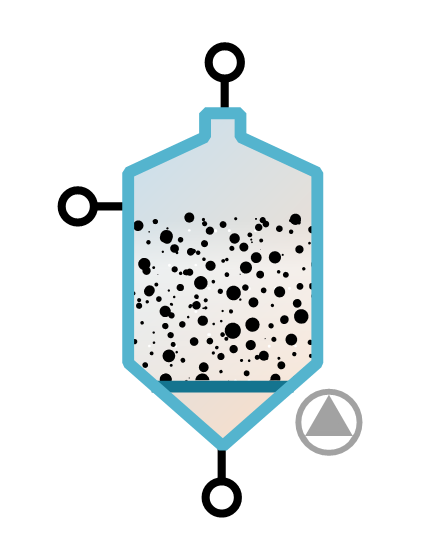 |
The Granular Activated Carbon unit is prepared to model the adsorption process of an activated carbon bed by removing soluble components from the feed. |
|---|
The GAC unit is specified via bed volume and surface area, while the activated carbon specification asks for TOC adsorption capacity (g C/g) at breakpoint as input parameter. The removal efficiency of each model component is a user input. The process unit is built as a volumeless separator without reactive volume, using mass balance expressed from adsorption specification. Based on the inputs the following options are available to simulate GAC process:
Process flow modeling concept:
- Continuous
- Cyclic
Bed replacement process initiation:
- Lifespan-based
- Breakthrough-based - only in Continuous concept
- Breakthrough-based with - only in Cyclic concept
- Total adsorbed carbon (modeled adsorbed carbon on bed)
- Treated water TOC (similar to real procedure)
- Volumetric load-based (number of bed volumes) - only in with Cyclic concept
The Continuous process either distributes the backwash flow and replacement evenly over the user defined period (Lifespan) or combined with loading and adsorption capacity, the breakthrough is estimated and initiates the bed replacement process.
The Cyclic concept utilizes the power of dynamic simulation: based on the activated carbon specification and backwash setup, the loading will define the time of the bed replacement for breakthrough-based and volumetric load-based model concepts.
¶ BAC
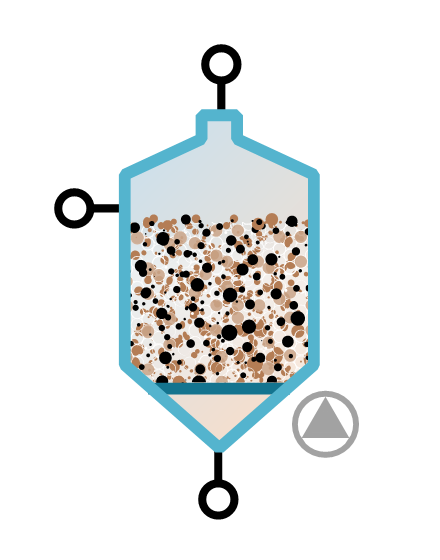 |
The Biological Activated Carbon unit is prepared to model the impact of microorganisms growing on the surface of an activated carbon bed, combined with the adsorption process, by removing soluble components from the feed. |
|---|
This process unit is built by combining a reactive CSTR unit (to mimic the biofilm activity) and a GAC unit (to capture the impact of the adsorption process). The BAC unit is specified via bed volume and surface area, while the activated carbon specification asks for TOC adsorption capacity (g C/g) at breakpoint and biofilm specification as input parameter. The additional removal efficiency of model components by the adsorption process is user input. Based on the inputs, the following options are available to simulate BAC process:
Process flow modeling concept:
- Continuous
Bed replacement process initiation:
- Lifespan-based
- Breakthrough-based
The Continuous process either distributes the backwash flow and replacement evenly over the user defined period (Lifespan) or combined with loading and adsorption capacity, the breakthrough is estimated and initiates the bed replacement process.
¶ Organic scavenger
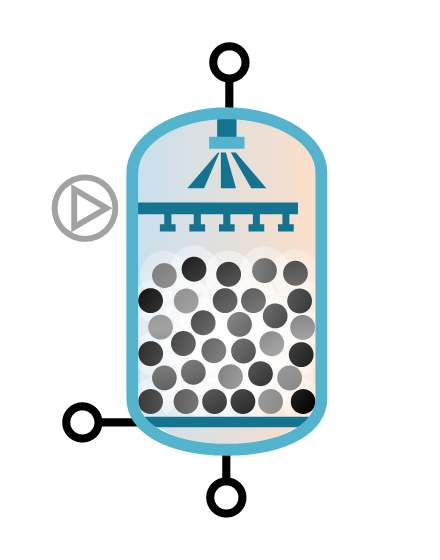 |
The Organic scavenger unit is a general organic adsorbent resin model with constant performance. |
|---|
The unit is developed for specialized SBA resin in the Cl- form with high affinity to large organic molecules. The resin's breakthrough capacity is user input. Applied as organic scavenger for capturing humic and fulvic substances, while removal of inorganic anions neglected, assumed to break instantly. The process unit is built as a volumeless separator without reactive volume, using mass balance expressed from adsorption specification as a focused colloidal and soluble organics-specific component separator. The following option is available in DYNAMIZU26:
- Hydraulics
- Volumeless
- Process flow modeling concept
- Continuous
- Type of ion exchange resin
- Cl- form SBA (strongly basic anion)
The Continuous process distributes the regeneration evenly, based on loading and adsorption capacity. The brine flow fraction is user defined.
¶ Cation Exchanger
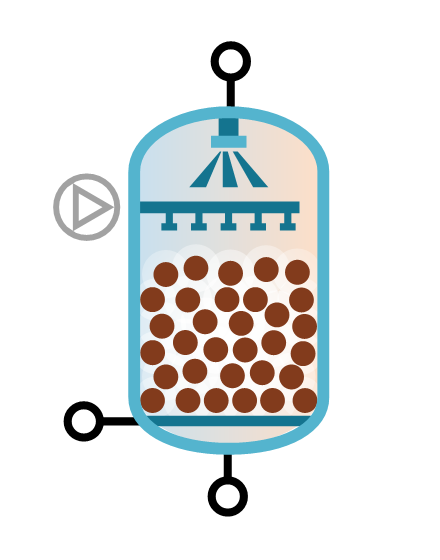 |
The cation exchanger unit is a general ion exchanger model with constant performance to capture the cation replacement process via resin. |
|---|
The unit is developed for specific resin composition as a cation specific component separator in a volumeless approach - biokinetic reactions are not accounted for. The resin's breakthrough capacity is user input. The regenerant calculation is based on mass balance; the regeneration frequency is not modeled (continuous approach). The removal/exchange efficiency of the model's cation components are user inputs. The following options are available to simulate the cation exchange process:
- Hydraulics
- Volumeless
- Process flow modeling concept
- Continuous
- Type of ion exchange resin
- H+ form SAC (strongly acidic cation)
- Na+ form SAC (strongly acidic cation)
- H+ form WAC (weakly acidic cation)
- Type of acid for regeneration
- Hydrochloric acid
- Sulfuric acid
The Continuous process distributes the regeneration evenly, based on loading and adsorption capacity. The brine flow fraction is user defined.
¶ Anion Exchanger
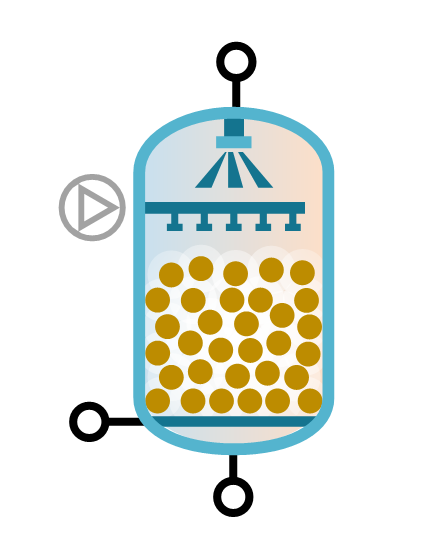 |
The anion exchanger unit is a general ion exchanger model with constant performance to capture the anion replacement process via resin. |
|---|
The unit is developed for specific resin composition as an anion specific component separator in a volumeless approach - biokinetic reactions are not accounted for. The resin's breakthrough capacity is user input. The regenerant calculation is based on mass balance; the regeneration frequency is not modeled (continuous approach). The removal/exchange efficiency of the model's anion components are user inputs. The following options are available to simulate the anion exchange process:
- Hydraulics
- Volumeless
- Process flow modeling concept
- Continuous
- Type of ion exchange resin
- OH- form SBA (strongly basic anion)
- Cl- form SBA (strongly basic anion)
- Free base WBA (weakly basic anion)
The Continuous process distributes the regeneration evenly, based on loading and adsorption capacity. The brine flow fraction is user defined.
¶ Mixed Bed Ion Exchanger
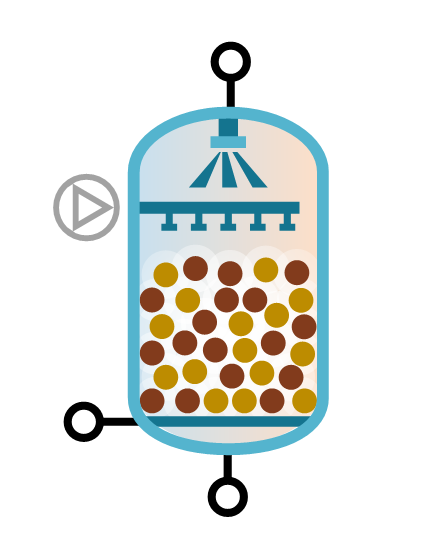 |
The Mixed Bed Ion Exchanger unit is a general ion exchanger model with constant performance to capture the cation and anion replacement process via resin. |
|---|
The unit is developed for specific resin composition as a cation and anion specific component separator in a volumeless approach - biokinetic reactions are not accounted for. The resin's breakthrough capacity is user input. The regenerant calculation is based on mass balance; the regeneration frequency is not modeled (continuous approach). The removal/exchange efficiency of the model's cation and anion components are user inputs. The following options are available to simulate the mixed bed ion exchange process:
- Hydraulics
- Volumeless
- Process flow modeling concept
- Continuous
- Type of cation ion exchange resin
- H+ form SAC (strongly acidic cation)
- Type of anion ion exchange resin
- OH- form SBA (strongly basic anion)
- Type of acid for regeneration
- Hydrochloric acid
- Sulfuric acid
The Continuous process distributes the regeneration evenly, based on loading and adsorption capacity. The brine flow fraction is user defined.
¶ Gas-liquid mass transfer units
¶ Air stripper
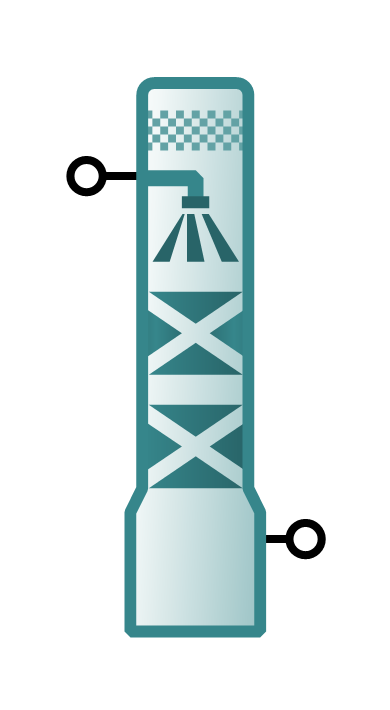 |
Degasser model with options for two levels of complexity (non-reactive volumeless point separator and compartmental model with reactions). |
|---|
This unit is suitable for the gas stripping operations of dissolved CO2, NH3 or CH4 as contaminants in industrial wastewater or process water.
The simplified volumeless model operates with user-defined input parameters accounting for the percent removal of dissolved gases. While the reactive compartmental column model predicts oxygen transfer and gas stripping based on gas-liquid mass transfer processes quantified by the aeration mechanism. The latter has been adapted to various types of aeration system specification (single and multi-hole sparger, coarse and fine bubble diffuser), relying on a set of equipment-specific correlations and parameters compiled by Deshpande et al., 2019 (https://doi.org/10.1016/j.ces.2019.05.011).
¶ Carbonator
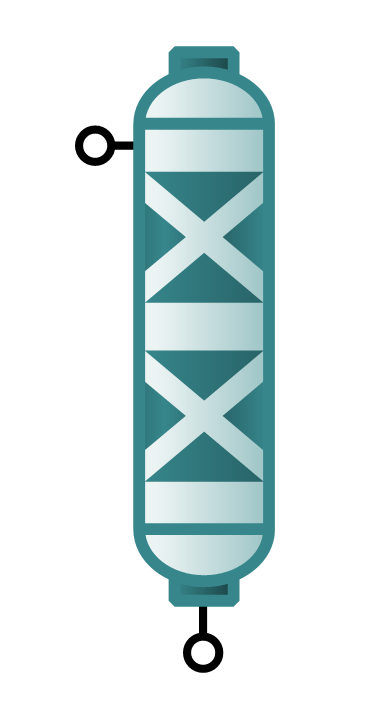 |
Compartmental carbonator model with calculated gas-liquid mass transfer. |
|---|
This unit process is similar in approach to the compartmental degasification model, however, it is specifically set up to act as a carbonator in drinking water production for the beverage industry or after lime softening, with the gas supply being predominantly composed of pure CO2. Neutralization of streams by CO2 injection may be simulated with the coupled equilibrium-based pH model of Dynamizu.
To adapt the tower unit process model to carbonators, regression parameters of the air stripper have been re-estimated, in order to describe the mass transfer characteristics of CO2 instead of O2, based on physical diffusion constants of the two gases.
¶ Heat transfer operations
¶ Evaporator
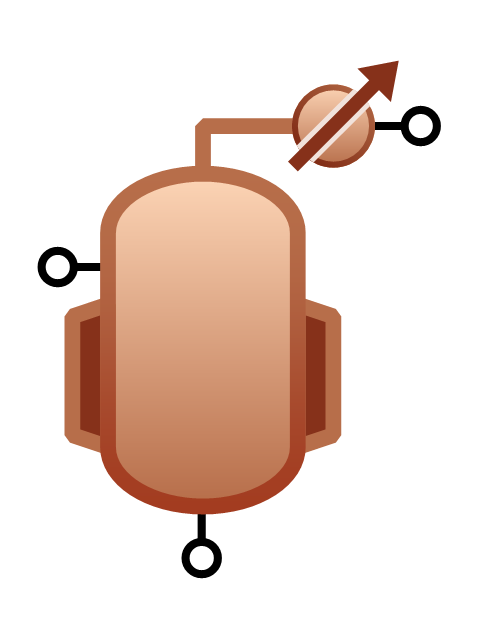 |
Volumeless point separator for modeling steam-driven single-effect evaporator for dilute solutions, with input heat transfer coefficient and input heat exchange surface. |
|---|
This unit performs an algebraic heat balance for the heat supply from steam and the heat demand of the incoming flow to evaporate via the provided heat exchange surface. Based on the result, three scenarios can happen:
- Part of the incoming water mass flow is evaporated (considering that all other components remain concentrated in the other fraction)
- In case of insufficient heat supply, no water mass becomes evaporated and the unit behaves as a liquid heater (the graphics turn to yellow in order to signal this operation mode)
- In case of heat oversupply, all water mass becomes evaporated and the concentrate flow reduces to zero (the graphics turn to red in order to signal this malfunctioning)
Latent heat recovery from the evaporate condensation is considered for internal preheating of the incoming flow in the unit.
¶ Heat exchanger
 |
Volumeless water/water heat exchanger surface model with input heat transfer coefficient. |
|---|
The heat exchanger unit employs the standard algebraic model, available for two geometrical configurations:
- Parallel flow (where the two liquid streams flow along the surface in the same direction)
- Counterflow (where the two liquid streams flow along the surface in the opposite direction)
¶ Temperature adjustment
 |
The temperature adjustment unit is prepared to calculate the energy demand of increasing the temperature of a liquid stream. |
|---|
¶ Special units
¶ Component separator
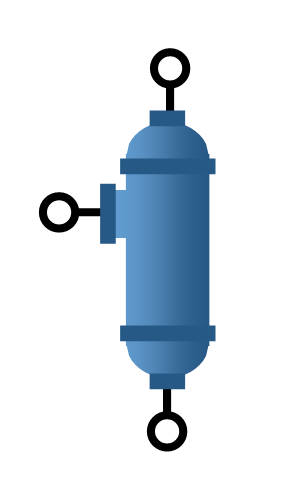 |
The component separator unit is a mass balance based volumeless non-reactive point separator model with specified underflow fraction and state variable mass split. |
|---|
This algebraic model provides an easy method for general state variable separation, specifying fixed removal efficiency for any state variable as input parameter.
¶ Ozonation unit
 |
The ozonation unit is modeling pathogens inactivation by employing an empirical dose-response relationship and the transformation of organic materials using a simple conversion method. |
|---|
Ozonation is a multipurpose technology in water treatment: it can be used for oxidation as well as organic material breakdown and disinfection; solely or in combination with chemicals and/or UV to enhance process efficiency. In the first release of DYNAMIZU, the modeling focus is set primarily on the disinfection effect and partially on the breakdown of organics (transformation of soluble unbiodegradable organic materials to biodegradable solubles).
The ozonation disinfection process is modeled by using the Hom equation to calculate the log removal of pathogens:

where
- N denotes the number of active pathogens
- k denotes the kinetic rate coefficient (m3/g/min)
- C denotes the concentration of effective O3 (mg/L)
- n denotes the chemical exponent (-)
- m denotes the time exponent (-)
- t denotes the hydraulic residence time in the unit (min)
The effective ozone concentration is calculated from the dosed ozone mass flow and a user-estimated fraction of residual ozone, accounting for the amount of ozone that is consumed by other processes (e.g. oxidation) that are currently not modeled for the sake of simplicity. This approach still allows for an easy evaluation of various ozonation effectiveness scenarios.
The conversion of soluble unbiodegradable organics to soluble biodegradables is based on a user-specified conversion ratio and adjusting for ammonia, phosphate and carbon-dioxide content.
¶ UV unit
 |
The UV unit is modeling pathogens inactivation by employing an empirical dose-response relationship. |
|---|
UV lamps are often used for disinfection purposes, known to efficiently inactivate most bacteria and protozoa as well as viruses. The working principle of this technology is based on the DNA-destruction effect of UV-C rays, preventing pathogens from further reproducing.
UV inactivation is modeled in DYNAMIZU using the Oppenheimer equation, where log removal is calculated from the logarithm of the effective UV dose D and the empirical coefficients a and b as presented below:

The emitted UV dose is calculated from the residence time in the unit (derived from the volume and the actual flow), the UV lamp power intensity and the number and surface area of the individual UV lamps. The effective dose depends on several factors affecting the UV transmittance in the treated water: clarity of water (turbidity: NTU<1 is advised), scaling (from water hardness) and fouling (biofilm growth) on the surface of the lamps, particle-bound fraction of pathogens (providing a shielding effect) as well as the ageing of UV lamps (deterioration). In the first release of DYNAMIZU, the fraction of effective UV dose is made available for adjustment as a user input parameter, providing the flexibility to set up customized dynamic input tables in order to mimic the aforementioned factors in a lumped approach (based on user experience with the equipment and the actual water matrix).
¶ Energy units
¶ Aeration units
¶ Blower energy calculator

|

|

|
Blower energy calculator unit to calculate the power demand of the process required airflow. |
|---|
The unit is called Blower energy calculator as it is using the process model calculated input air flow and defines the blower operation point to calculate the power demand and energy consumption. Undersized blower will not impact the performance of the process model but will indicate the fact of undersized blower.
Three types of energy calculation options are available, based on:
- empirical model (considering input efficiency model for pneumatic power demand)
- positive displacement blower (detailed blower curves to calculate blower efficiency and power demand)
- turbo blower (detailed blower curves to calculate blower efficiency and power demand)
¶ Connectors
¶ Air connector
 |
Airflow connector to allow to supply multiple aerated tanks from a single blower group. |
|---|
¶ Air combiner
 |
Airflow combiner to allow to distribute the airflow demand between different blower groups. |
|---|
¶ Plantwide units
The goal of plantwide units is to allow the user to set up calculation between different units in the same project. Typical use cases are controllers where the control variable may be at different location as the manipulated variable.
¶ Controllers
¶ Conditional controller
 |
The conditional controller is a discrete IF controller: defines the manipulated variable based on the control variable relation to the condition value at discrete time step. |
|---|
¶ Continuous P controller
 |
The continuous P controller is using the proportional part of the discrete PID controller. It is continuous as the manipulated variable is handled as state variables: it is recalculated every integration step. |
|---|
¶ Deadband controller
 |
Deadband controller can be configured to switch the manipulated variable between a lower and higher value based on the value of the control variable compared to a control range. |
|---|
¶ PID controller
 |
Discrete PID controller, velocity form. The manipulated variable is recalculated at every predefined time step. Proportional, integral and derivative gains are input parameters. |
|---|
¶ Ratio controller
 |
Ratio controller is a continuous controller where the manipulated variable value and the control variable ratio is fixed through a user defined parameter value. |
|---|
¶ Step controller
 |
The step controller sets the manipulated variable based on control variable range evaluation: if the control variable is in a predefined range, the relevant manipulated variable will be used, otherwise an out of boundaries output is set up. Discrete controller, with user defined number of ranges. |
|---|
¶ Switch controller
 |
Switch controller continuously changes the manipulated variable between two values depending on the control variable value compared to a threshold. |
|---|
¶ Time based on-off controller
 |
Time based on/off controller changes the manipulated variable between two values based on user defined cycles. |
|---|
¶ Statistics
Statistical units are helpful tools to generate results from the simulation in the form they are needed for comparison with measurements.
¶ Cycle based totalizer
 |
Cycle based totalizer integrates a variable for the cycle time set up by the user. It can provide the total daily flow from an hourly based dynamic input table of influent flow. |
|---|
¶ Min/Max
 |
Min/Max unit is a continuous value sampling unit which every step stores the minimum and maximum variable value of the simulation period and provides it as output for the user. |
|---|
¶ Monthly average
 |
Monthly average unit is a discrete value sampling unit at every given timestep and calculates the average based on the month of the simulation. Date based dynamic input has to be set up for month evaluation. |
|---|
¶ Moving average
 |
Moving average unit is a discrete value sampling unit which every given timestep stores the variable value and provides the average for the user defined average time period. |
|---|
¶ Noise
 |
Noise unit places measurement noise upon a variable. The noise can be white or Gaussian. |
|---|
¶ Response time
 |
The response time unit applies a zero order delay function on the measured variable to mimic the impact of sensor response time. |
|---|
¶ Totalizer
 |
Totalizer unit integrates a selected variable for the simulation time. |
|---|